

Generally speaking, a new roof in the Atlanta area typically runs somewhere between $8,000 and $30,000. Still, if you’re wondering how much a new roof will cost on your home, it depends on three things more than anything else – the size of your roof, the material you choose, and how complicated the job turns out to be once a contractor gets up there and assesses the situation. While a small, simple roof in architectural shingle sits at the lower end of the range, a large roof with a steep pitch, multiple valleys, or a premium material like metal or tile can push well past it.
In this guide, we break down exactly where your roofing project is likely to land cost-wise and why, section by section, so you’re not guessing when a contractor hands you a number.
Cost by Roof Size
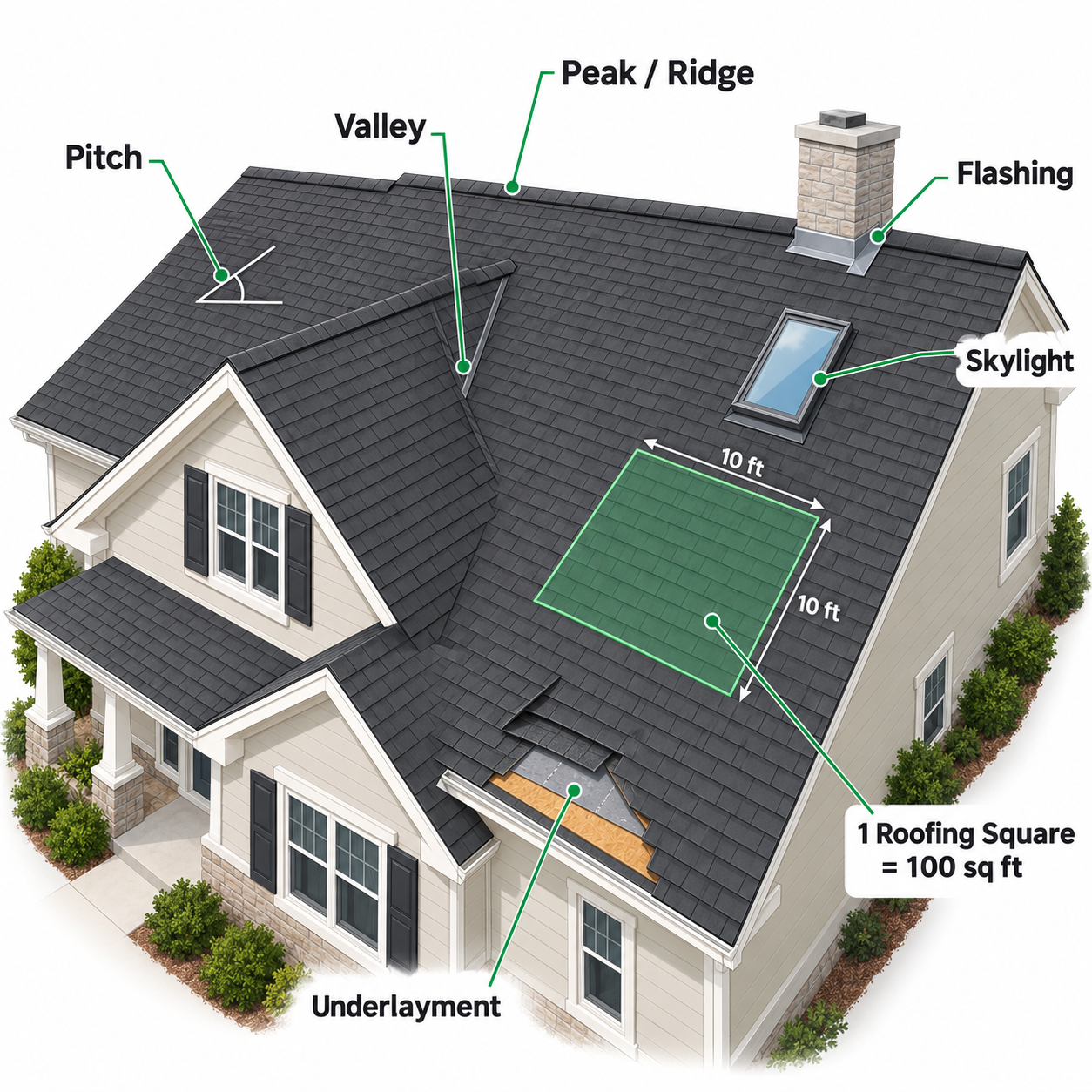
Roofing jobs are priced by the roofing square, which is equal to 100 square feet of roof service (not 100 square feet of house). A single-story home with a simple gable roof might have a roof surface close to its floor plan size; but a home with a steep pitch, dormers, or a complex roofline can have significantly more roof surface than square footage would suggest. That’s one of the more common surprises homeowners run into when comparing a contractor’s estimate to a number they found online – two houses with identical square footage can need a meaningfully different number of roofing squares depending on the roof shape alone.
| Home Size (approx.) | Typical Roofing Squares | Estimated Cost Range* |
|---|---|---|
| 1,200–1,500 sq ft | 15–18 squares | $8000 – $14,000 |
| 1,500–2,000 sq ft | 18–24 squares | $11,000 – $18,000 |
| 2,000–2,800 sq ft | 24–32 squares | $15,000 – $24,000 |
| 2,800+ sq ft | 32+ squares | $20,000 – $30,000 |
*Ranges reflect standard architectural asphalt shingle on a moderate-complexity roof. Steeper pitches, more cutting, or premium materials move these numbers up — see the breakdowns below.
If you want a quick way to sanity-check an estimate, do this: multiply your home’s footprint by roughly 1.2 to 1.5 to account for roof overhang and pitch, divide by 100, and you’ll land in the neighborhood of your actual roofing squares. This is a gut check and shouldn’t be used as a measured professional estimate, but it explains much of the gap between what people expect to pay and what a quote actually says.
Cost by Roofing Material
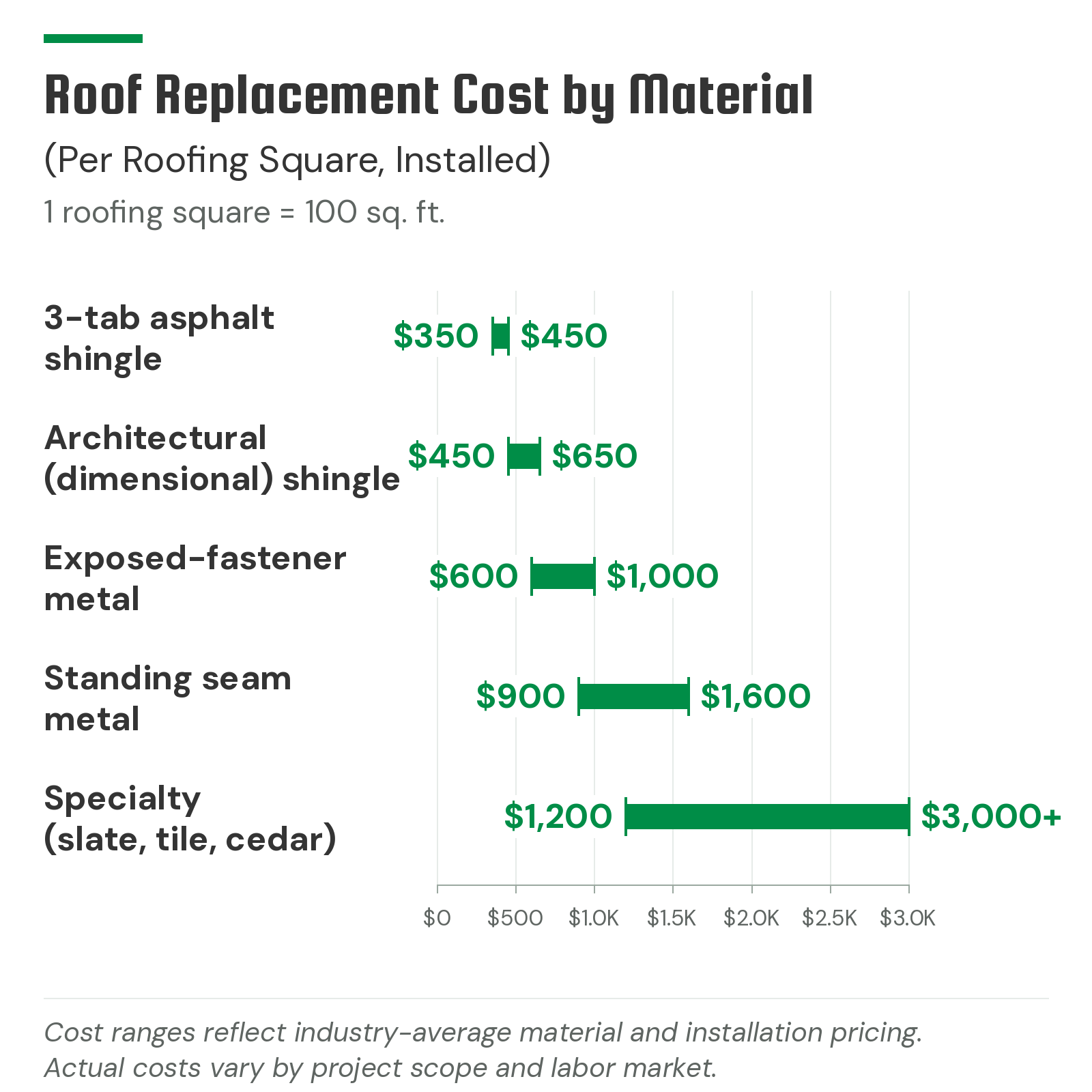
Material typically represents the single biggest line item on a quote, so it’s worth understanding why the price spread between options can be substantially different. Three things drive the price difference: the cost of the material itself, how much labor and specialized skill it takes to install correctly, and how long it’s expected to last before it needs replacing again. A cheaper material that needs replacing twice as often isn’t necessarily a better deal – it just moves the cost further down the timeline.
| Material | Estimated Cost per Square (Installed) | Typical Lifespan | Notes |
|---|---|---|---|
| 3-tab asphalt shingle | $350 – $450 | 15–20 years | Budget option, flat appearance, fewer warranty options from manufacturers |
| Architectural (dimensional) shingle | $450 – $650 | 25–30 years | Most common choice in Atlanta, better wind and impact resistance |
| Standing seam metal | $900 – $1,600 | 40–60 years | Higher upfront cost, interlocking panel seams, minimal maintenance |
| Exposed-fastener metal | $600 – $1,000 | 30–45 years | Lower-cost metal option, visible screws require periodic re-tightening |
| Specialty (slate, tile, cedar) | $1,200 – $3,000+ | 50–100 years | Longest lifespan, heaviest structural demands |
Here’s what’s actually behind those numbers, material by material — and where the real tradeoffs are, beyond just the price tag:
Asphalt shingles are where most Atlanta roofing decisions start, and the jump from 3-tab to architectural is almost always worth the extra cost. 3-tab shingles are a single flat layer with less wind resistance — a real consideration here given the straight-line wind events that come through with summer storms. Architectural shingles are built with a laminated, multi-layer design that handles wind and impact better, and most manufacturers now expect architectural shingles for their stronger warranty tiers, which is important if storm damage coverage is part of your decision later.
Metal roofing splits into two very different products at very different price points, and the gap in the table above isn’t a small distinction. Standing seam panels interlock with concealed fasteners, which is what gives them their long lifespan and clean look. However, the installation requires specialized crews and equipment, which is most of what you’re paying for in that higher per-square number. Exposed-fastener panels cost less because they’re faster to install, but the visible screws need periodic re-tightening or replacement as the panels expand and contract with temperature. In this case, the lower upfront cost comes with a maintenance commitment. For a closer look at the panel types and where each makes sense, check out our metal roofing page.
Specialty materials (like slate, clay or concrete tile, and cedar shake) sit at the top of the cost range for a structural reason as much as an aesthetic one: they’re significantly heavier than asphalt or metal, and older homes sometimes need a structural engineer to confirm the roof framing can support the added weight before installation even starts. That’s an extra step (and potential extra cost) that doesn’t show up on an asphalt or metal quote. If you’re considering one of these materials, our specialty shingle services page covers what that evaluation process looks like. If color and style are part of the decision regardless of material, the shingle color options available for a roof replacement are worth a look before you finalize anything.
One more note on pricing that gets missed often: “per square” quotes can mean materials only, or fully installed (materials, labor, tear-off, and disposal together). Make sure any quote you’re comparing is apples to apples. Ask directly which it includes, and ask whether the number assumes your existing decking is in good condition, since decking repair is a common add-on cost that surprises people mid-project.
The 5 Factors That Drive Your Roof’s Cost
Size and material get you most of the way to a ballpark number, but they don’t explain the full spread within a given range. Two homes of the same size, with the same shingle, can still land $2,000 or more apart once a contractor actually gets on the roof. The five factors below are what account for that gap, and understanding them ahead of time means fewer surprises once an inspector shows up with a tape measure and a ladder.
Price Factor 1: Materials
Material choice sets the floor and ceiling of your budget, but the primary roofing material isn’t the only material cost you’ll incur. Flashing around chimneys, vents, and skylights, and the underlayment beneath the shingles, add to the total if they need replacing too. Underlayment itself varies in cost — synthetic underlayment has largely replaced older felt products because it holds up better to the heat and humidity swings Atlanta sees across a year. Furthermore, ice-and-water shield (a more expensive, fully adhered membrane) is often added around valleys and eaves even this far south, particularly on homes in the higher-elevation parts of north Georgia near Dalton and Ellijay. Sometimes flashing and underlayment are still in good shape and can stay as-is. Sometimes they can’t, and that raises the price more than people expect going in.
Price Factor 2: Roof Pitch
A steep roof is a harder, slower, riskier job, and the cost impact is directly tied to how steep is actually “steep.” Roofs steeper than roughly a 6:12 pitch (6 inches of rise for every 12 inches of horizontal run) generally stop being safely walkable without harnesses and roof jacks. Likewise, anything approaching 9:12 or beyond requires significant additional safety equipment and slower, more deliberate work from the crew. That extra time and equipment shows up directly in labor cost, and it’s also why insurance rates for roofing crews (which get baked into the price you’re quoted) go up on steep work. Valleys, peaks, and skylights compound this further, since each one means more cutting, more flashing, and more time, regardless of the overall pitch.
If you want to understand exactly how pitch is measured and why it matters so much to pricing, we’ve broken it down separately here.
Price Factor 3: Removing the Old Roof
Georgia building code generally allows a maximum of two shingle layers on most residential roofs before a full tear-off is required, though this can vary by local jurisdiction and is worth confirming with your specific county or city permitting office. Older homes — and homes that have changed hands a few times without a full roofing history — sometimes have more layers than code allows, either from past re-roofs that didn’t follow code or additions that were never properly tied in.
Every layer has to come off before new material goes down, and that torn-off material has to be hauled away and disposed of, which usually means dumpster or trailer rental and disposal fees that scale with the size of the job. This is a cost that’s easy to overlook when comparing quotes side by side, but it can add real money to a job with multiple layers. It’s also the point in a project where decking damage usually gets discovered, since you can’t see the condition of the decking until the old material is off.
Price Factor 4: Roof Accessibility
The ease of physically getting materials onto your roof, and for workers to work safely around it, affects price more than most homeowners expect. A roof tucked close to neighboring homes, surrounded by mature trees, or set far back from where a delivery truck can park all make the job slower. These situations sometimes require specialized equipment, like a conveyor system or crane to move material up, rather than a crew carrying it by hand.
If your home has large trees near the roofline, which is common across most of Atlanta’s older, tree-covered neighborhoods, expect accessibility to come up as a factor during your inspection, along with a conversation about protecting landscaping during the job. Power lines running close to the roofline and HOA restrictions on dumpster placement or work hours, both common in established subdivisions throughout the metro area, can add scheduling complexity as well, even if they don’t directly change the price.
Price Factor 5: Roof Size
Bigger roofs need more material and more labor hours, in direct proportion. That’s exactly why the table above is a good place to start when estimating your own project.
But size isn’t just square footage; roof complexity multiplies it. A simple gable roof and a roof with multiple hips, valleys, and dormers can cover the same square footage and still require meaningfully different amounts of material, because every seam, valley, and edge needs additional cutting and flashing work that a simple rectangular roof doesn’t. Most estimates build in a waste factor, meaning extra material ordered to account for that cutting, typically somewhere in the 10 to 15 percent range, and higher for more complex roofs.
Local Cost Factors Across Metro Atlanta and North Georgia
Costs shift slightly across the areas we serve — not because pricing varies by zip code, but because labor availability, permitting timelines, terrain, and the typical age and size of homes aren’t identical from one county to the next.
In Johns Creek and the surrounding north Fulton area, mature tree cover is common, which means accessibility comes up more often than it might in a newer subdivision. Homes here also tend to run larger than the metro average, which pushes projects toward the higher end of the estimated range more often than not.
In Cherokee County, including Woodstock and Canton, there’s a real split in housing stock. Newer developments tend to have simpler roof geometry. Older farmhouses and properties on larger lots often come with more complex rooflines, steeper pitches, and heavier tree cover, which brings accessibility into play too. If you fall into the second category, say so upfront. A rough estimate based on square footage alone can look very different once a contractor actually inspects a roof like that in person.
In Forsyth County, including Cumming, rapid residential growth over the past two decades means a wide mix of roof ages — a meaningful share of homes here are approaching the point where a first full replacement makes more financial sense than another round of repairs, and newer large-format homes in the area’s bigger subdivisions often land at the higher end of the size scale.
We also serve Jasper and the broader North Georgia foothills, where larger lot sizes, steeper regional terrain, and higher elevation are common factors in a quote. That elevation is a bigger factor than a lot of homeowners realize. It’s a major part of why ice-and-water shield tends to come up in the inspection conversation more often in this part of our service area than it does closer to downtown Atlanta.
Permits and Project Timeline in Metro Atlanta
Most residential roof replacements in Georgia require a building permit. The specific process, including the application, inspection requirements, and turnaround time, varies by the city or county you’re in rather than being standardized across the metro area. A licensed roofing contractor should handle pulling the permit as part of the job rather than leaving that step to the homeowner. The permit itself is typically a small line item relative to the overall project, but it’s worth confirming it’s included in any quote you’re comparing.
Regarding the timeline, a straightforward asphalt shingle replacement on an average-size home is often a one-day job once work actually starts, weather permitting. Larger homes, steeper roofs, metal roofing, or jobs that turn up decking damage once the old material is off can extend that to several days. The bigger variable for most homeowners isn’t the installation itself but the scheduling lead time to get on a contractor’s calendar. Spring and early summer line up with Georgia’s storm season, which tends to be the busiest stretch of the year for roofing companies across the metro area. A quote obtained in March may come with a longer wait than one obtained in October.
Getting a Roofing Quote in Atlanta: What to Actually Expect
If you’ve gotten a quote and it feels high, don’t assume you’re being overcharged — get at least one more estimate before deciding. If a quote feels surprisingly low, that’s worth more scrutiny, not less: missing scope (no tear-off, no permit, cheaper underlayment) is a common reason a number looks good on paper and turns into change orders later. Price matters, but it’s rarely the only thing that should decide who replaces one of the biggest investments your home will need.
A thorough free roofing estimate should include a full inspection of your current roof. That means not just the shingles, but the decking underneath, the flashing, and the attic ventilation. It should also come with a written quote that itemizes material, labor, tear-off and disposal, and any permit fees, so you can actually compare it to other estimates line by line. If what you’re trying to decide is whether you need a full replacement at all, it’s worth a quick read on the difference between a roof repair and a full replacement before you commit to either path.
Cost is often a significant decision factor in roof replacement, and plenty of homeowners finance the project rather than pay out of pocket. If that’s part of your decision, see what financing options are available.
You can get a free roofing estimate from Findlay Roofing to see exactly where your project falls within these ranges.
Frequently Asked Questions
How much does a new roof cost in Atlanta?
Most Atlanta homeowners spend between $8,000 and $30,000 on a full roof replacement, with architectural shingle on an average-size home typically landing in the 11,000–18,000 range. Size, material, and roof complexity are the three biggest factors in where your project falls.
What is the average cost of roof replacement in Atlanta?
There isn’t one single average that applies to every home — a 1,500 sq ft home with a simple roofline and asphalt shingle will cost far less than a 3,000 sq ft home with a steep roof and metal roofing. The size and material tables above are a better starting point than any single average number.
Does a roof replacement cost include tear-off and disposal?
Not always — this is one of the most common gaps between a low quote and a complete one. Always ask whether a quote includes removing and disposing of your existing roof, since that’s a real cost that has to be covered somewhere.
Do I need a permit to replace my roof in Georgia?
In most cases, yes. Requirements and turnaround times vary by city and county, so this is usually handled by your contractor as part of the job rather than something you need to manage yourself — but it’s worth confirming it’s included in your quote.
How long does a roof replacement take?
A standard asphalt shingle replacement on an average-size home is often completed in a single day once work begins. Larger roofs, steep pitches, metal roofing, or unexpected decking repairs can extend that timeline, and scheduling lead time tends to be longer during spring and early summer storm season.
Will homeowners insurance cover any of the cost?
It depends on the cause. Damage from a storm or falling tree is often covered, while wear from age typically isn’t. If your roof was recently damaged by weather, our storm damage repair page covers what the insurance claims process usually looks like.
How long does a new roof last in Georgia?
It depends heavily on material — architectural shingle, metal, and specialty materials all have different expected lifespans in Georgia’s climate. We cover typical roof lifespans by material here in more detail.


